Rifkin family home in Newton
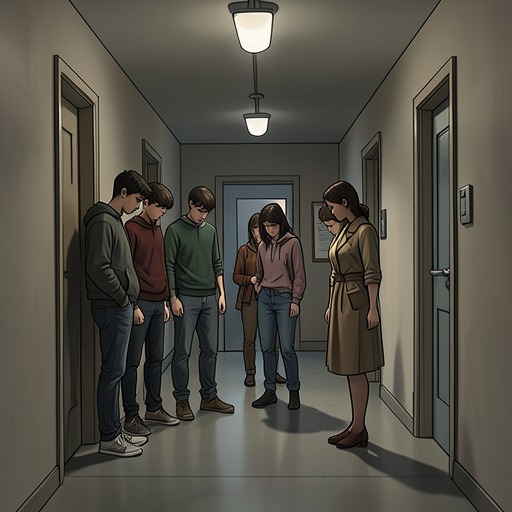
Defending JacobThe Rifkin family home in Newton is the setting for the shiva after Ben Rifkin’s murder, where a town’s public attention presses into a family’s private mourning. Within its crowded rooms, the house also becomes the site of a quieter encounter between Andrew Barber, the investigator on the case, and Dan Rifkin, Ben’s father, whose questions reach beyond evidence toward the endurance of grief.## Mourning in public When the Rifkins opened their home for shiva, the Jewish period of mourning, people arrived in such numbers that the family could not grieve privately. Ben’s murder had become a public event, and mourning seemed public too. The crowd’s conversation swelled at moments toward the awkwardness of a party, then dropped together, as if an unseen hand had lowered its volume. Visitors made room for one another, while some watched Andrew Barber pass and recognized him as the person handling the case. In those first days, the investigation’s details receded behind the stark fact of a child’s death.
The house held distinct circles of loss. Ben’s friends gathered in a small front den; his grieving relatives occupied the living room. In the kitchen, parents whose children had attended Newton schools together found what Andrew calls their crowd. They had shared years of kindergarten drop-offs, pickups, soccer games, fund-raisers, and a school production of Twelve Angry Men, yet many were acquaintances rather than close friends. Their fellowship had an expiration date: most such connections would not outlast their children’s graduation. In the immediate aftermath of Ben’s death, however, the parents felt an abrupt, almost illusory intimacy, as if they had suddenly been disclosed to one another.
That sense of closeness took a concrete form in the kitchen. Parents gathered in small groups and spoke of insomnia, sadness, and dread, returning to Columbine and September 11 as they described holding their own children closer. The room’s warm light and the surrounding luxury—its cooktop, refrigerator, granite counters, and pale cabinets—set the confessions within an ordinary domestic space. Toby Lanzman, Laurie Barber’s best friend, arranged food at the kitchen island with a dish towel over her shoulder. She was one of the few durable connections the Barbers had made in town, and when Andrew entered looking for Laurie, Toby pointed him toward her. Laurie, she said, was tending to the other mothers.
A private conversation inside the house
Away from the gathering, Andrew searched upstairs for his coat and entered a dim bedroom illuminated by a brass floor lamp. Dan Rifkin sat alone in a chair. His carefully arranged appearance included an expensive dark suit with a tear in its lapel, worn to signify his broken heart; his face showed the effects of grief. The contrast between the packed house and this secluded room turns the home from a communal gathering place into a setting for one father’s solitary reckoning.
Dan asked whether there was any news. Andrew had none. Dan explained that he came to this room to think, and that a death like Ben’s left him with time and questions. He did not want to discuss only evidence or court procedure; he wanted to understand why someone would commit the murder. Andrew tried to redirect him, but Dan insisted that he was rational and wanted answers of a different kind. The conversation makes the gap between the case and the loss plain: Andrew can speak to investigative developments, but those developments cannot explain the death to a father seeking meaning.
Dan’s questions turned toward survival. He wanted to know what helped bereaved parents make it through, whether there was a pattern or a set of practices that worked. Andrew answered that survivors relied on family and other people, including support groups, and encouraged Dan to speak with a victim advocate who could connect him to one. He emphasized that Dan did not have to go through it alone. Dan then asked what happened to the parents who never recovered. The exchange does not resolve that fear; it leaves the house holding a question no procedural answer can settle.
The house and the remembered landscape
The Rifkin home’s role in the narrative extends beyond the shiva. During a later account of the park search, Andrew recalls Dan approaching alone across a broad, empty expanse of playing fields. Seen from a distance, Dan appears small against the green space, his head bowed and his hands in his coat pockets; the wind repeatedly pushes him off course, and he zigzags like a small boat moving into the wind. Andrew remembers this as his lasting image of Dan in misery. The recollection shifts the setting from the crowded house to open ground, but carries forward the same isolation that the private bedroom disclosed.
That later image also complicates the closeness the kitchen crowd seemed to offer. At the shiva, shared fear and confession briefly made school parents feel newly connected; at the park, Dan’s grief is rendered as a solitary figure crossing an empty field. The home is thus both a place where a community gathers around bereavement and a point of contrast for the loneliness that communal attention cannot remove.## Narrative significance The house anchors a narrative concerned with the difference between public events and the unremarkable time that follows them. Looking back after Jacob Barber’s exoneration, Andrew reflects that lives are made of many ordinary days and only a few momentous ones, while the ending of one event does not mean life itself has ended. The shiva belongs to the public aftermath of Ben’s murder, but the home’s scenes resist the idea that a public ritual or a developing investigation can contain grief. Dan’s unresolved questions and Andrew’s later memory of him make the house a place of witness: a setting where loss is shared, observed, and given a voice, but not brought to a conclusion.